

Understanding the crucial distinctions between “independent contractor vs employee” is essential for protecting your business and ensuring compliance. This guide simplifies the rules, helping you avoid costly mistakes.
Misclassification Could Cost You Thousands—Here’s How to Avoid It
If you run a small business, you’ve probably hired people as 1099 contractors instead of bringing them on as W-2 employees. It’s easy to see why—it saves time, reduces paperwork, and lowers payroll costs. But there’s a catch: if the government decides you misclassified a worker, you could be in for a rude awakening.

What is misclassification?
Misclassification refers to incorrectly categorizing a worker as an independent contractor instead of an employee. This mistake often occurs when an employer treats a worker as a 1099 contractor to avoid payroll taxes, benefits, and labor law requirements despite the worker meeting the legal criteria of a W-2 employee.
Misclassification can lead to serious legal and financial consequences, including fines, back taxes, wage claims, and government audits.
Increased audits by federal and state agencies are catching businesses in the act, and the penalties are steep. Just look at these real-life cases:
- A Philadelphia contractor misclassified six workers and was fined $85,000, plus back wages and penalties.
- A marketing agency paid $75,000 when a so-called “freelancer” sued for wrongful termination, arguing they had worked full-time under company control.
- A restaurant was forced to pay $120,000 after a worker, labeled a 1099 contractor, was injured and denied workers’ comp benefits.
Think this can’t happen to you? Let’s break it down.
How the Government Decides Who’s an Employee
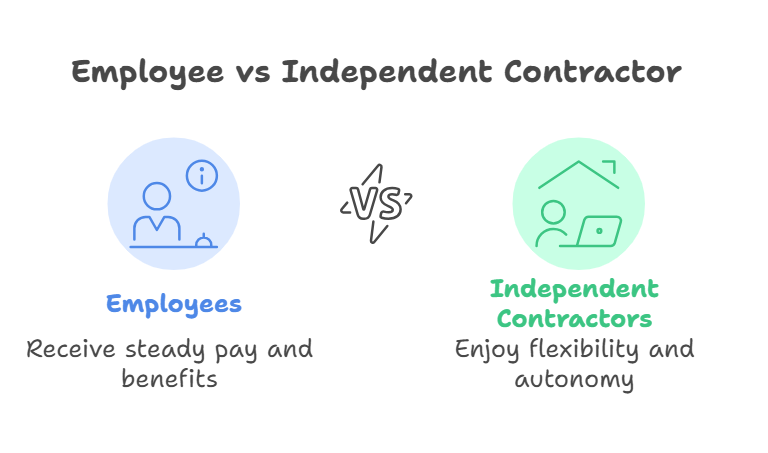
The IRS, Department of Labor (DOL), and state governments don’t care what you call your workers. They look at how they work. While there’s no single test, here are the three most significant factors:
1. Who Controls the Work?
- Employees: You decide their schedule, tasks, and how they do the job.
- Contractors: They set their hours and methods, working on their terms.
2. How Are They Paid?
- Employees: Get a salary, hourly wage, or steady paycheck.
- Contractors: Send invoices and negotiate their own rates.
3. How Essential Is Their Role?
- Employees: Their work is crucial to your daily operations.
- Contractors: They provide a specialized service and often work for multiple clients.
The DOL’s “economic reality test” digs even deeper. They look at things like:
- Who takes the financial risk? Employees don’t. Contractors do.
- Who buys tools and equipment? Employees get them from you. Contractors provide their own.
- How long is the relationship? Employees stay long-term. Contractors work on projects by project.
💡 Bottom line: If you control how they work and depend on your income, they’re probably employees, even if their contract says otherwise.
The Cost of Getting It Wrong
Ignoring these rules can be an expensive mistake. Here’s what’s on the line:
💸 IRS Fines & Back Taxes
You could owe payroll taxes, penalties, and interest for every misclassified worker.
💸 Wage & Hour Lawsuits
Workers can sue for unpaid overtime, minimum wage violations, and lost benefits.
💸 Workers’ Comp & Unemployment Claims
If a 1099 worker gets injured or laid off, they may file claims, and you could be on the hook.
💸 State & Federal Audits
Once one agency finds an issue, others tend to follow. Expect more scrutiny.
How to Protect Your Business
Don’t wait for an audit to force your hand. Take these steps now:
✅ Review Your Workforce
Check if your independent contractors truly meet the legal criteria.
✅ Fix Your Contracts
Ensure 1099 agreements outline independent work terms—and reflect reality.
✅ Reclassify If Needed
If a worker looks more like an employee, switch them to W-2 before it’s too late.
✅ Get Expert Help
An HR compliance expert can review your setup and help you avoid costly mistakes.
Need Help Sorting This Out?
Getting worker classification wrong can be a costly nightmare. But fixing it now could save you thousands. If you’re unsure, let’s talk.
📩 Download Your Free HR Compliance Guide Here💡 Take action now—before an audit does it for you. Book an HR audit today and protect your business!





0 Comments